Understand how you think. Then build around it.
A written profile of how a brain prefers to take in information, make decisions, communicate and recharge, with practical next steps you can use at home, at school and at work.

Every NBI® profile is scored and interpreted by Lauren Kyte, Certified NBI® Practitioner and Early Years specialist.
More on Lauren ↓You've read the report three times and you still don't know what to do on Monday morning.
You and your partner have the same argument about the same thing, and neither of you is wrong.
Your child is fine at school and falls apart the minute they walk through the door, and you want to understand why.
You're the person everything gets handed to, and you've started to wonder whether that's a strength or a problem.
Your team is capable, but somehow every meeting goes sideways in the same place.
The Neethling Brain Instruments (NBI®) is a questionnaire that measures thinking preferences: the ways of thinking that feel natural to you and the ones that take more effort. It's been used internationally for decades in education, coaching and business.
The questionnaire gives you a set of scores. A set of scores on its own doesn't change much. The written profile is where it becomes useful.
Every brain uses all four. We just prefer some more than others.
Understand
Facts, logic, accuracy, evidence. It wants to know what's true.
Plan
Structure, order, reliability, follow-through. It wants to know how things will work and what comes next.
Connect
People, communication, relationships. It notices the human side of a situation.
Imagine & Try
Possibility, ideas, change, exploration. It looks beyond what already exists.
Your preferences shape what you notice first, how you approach decisions and where your thinking energy goes. A deeper layer splits each of the four into two dimensions, which is often where the most useful findings turn up.
Colours shown match the NBI® four-preference report.
Preference is not ability
An NBI® profile doesn't measure intelligence, personality or ability. There's no best profile, and no preference is worth more than another. You may be very capable in an area where your preference is quieter. You may also prefer something strongly without having had the chance to build the skill for it yet. It isn't a diagnosis, and it doesn't replace one.
You get a written, printed document of 10 to 18 pages, depending on the profile, written in plain language and addressed to you.
The profiles go further than NBI® interpretation alone. Each one adds an executive functioning and coaching layer, so you finish with things to do, not just things to know.
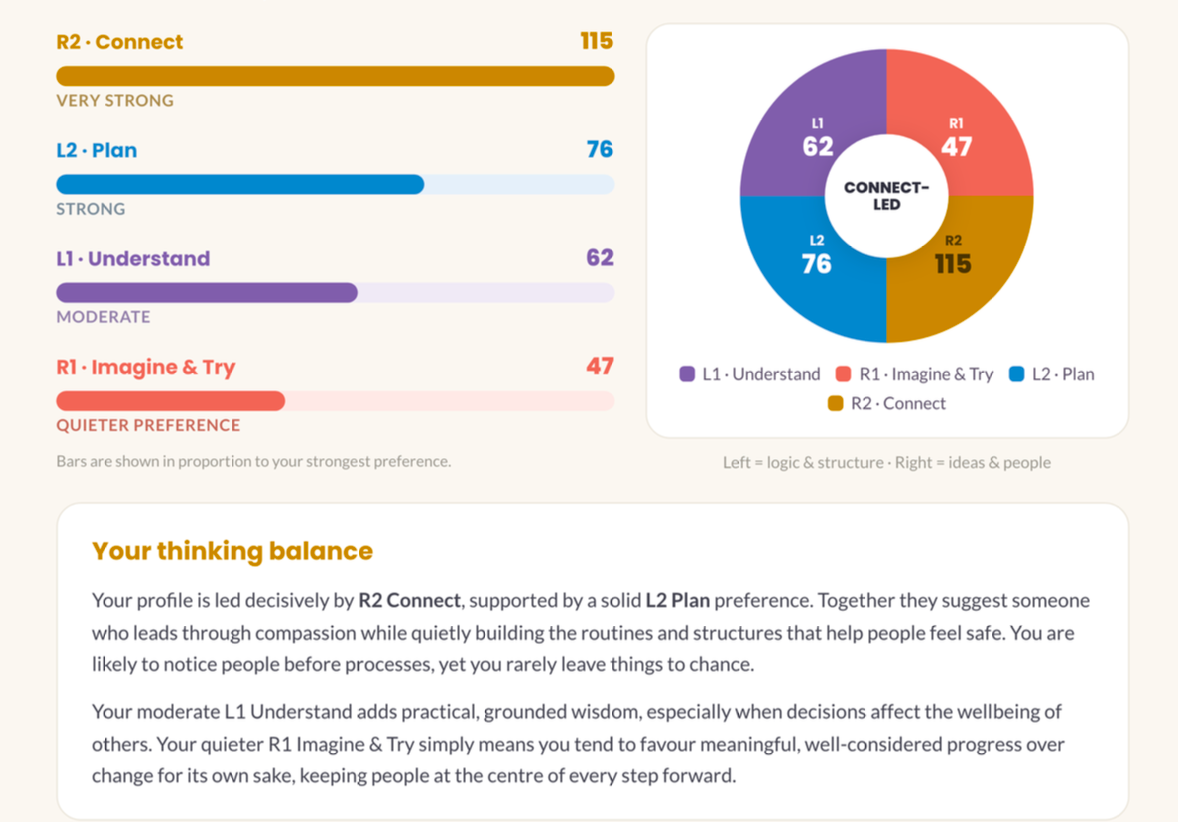
A personal profile covers
- your four-quadrant profile and the deeper eight-dimension layer
- energy and how you recharge
- what settles you under pressure
- connection and relationships
- home and family
- work, decisions and leadership
- communication and conflict
- how to work with you
- a personal roadmap of what to focus on
- a letter written to you
Child Brain Profile
For parents who want to understand how their child thinks and what helps.
Teen Brain Profile
For teenagers and the adults around them.
Parent Brain Profile
How you think as a parent, and how that meets your child's thinking.
Personal Brain Profile
For any adult, for work, relationships or simply understanding yourself.
Couple Connection Profile
Two profiles read side by side.
Family Connection Profile
How everyone in the household thinks, and where you meet and clash.
Teacher Brain Profile
How a teacher's thinking shapes their classroom.
School Leadership & Executive Profile
For leaders and leadership teams.
Team Report
The thinking make-up of a whole team, and what it means for how you work together.
A note on the Teen Career Profile
A Teen Career Profile is also available, alongside a Teen Brain Profile only. A career match means that people in that job tend to think in a similar way to the student. It doesn't mean they'd be good at it, enjoy it or get in. It isn't a careers test or an aptitude assessment, and it doesn't replace careers guidance.
The questionnaire
It's online, takes around 20 minutes, and there's nothing to prepare.
Scoring and interpretation
Lauren Kyte, a certified NBI® practitioner, scores and interprets every profile.
Your written profile
Your results are written up into your profile, with the practical strategies and roadmap built in.
Feedback (optional)
A one-to-one session to go through what it means and how to use it. You can have the profile on its own, or the profile and a conversation.
How profiling fits with coaching
A brain profile is step one of every coaching package I offer to adults, families and teens. You don't have to be a coaching client, though. Profiles stand on their own, and if coaching follows later, your profile counts as step one.
Lauren Kyte, Certified NBI® Practitioner
Early years specialist and trained teacher, founder of Future Steps Preschool, with a degree in psychology. She has over 20 years of experience profiling adults, children, families and executive teams.
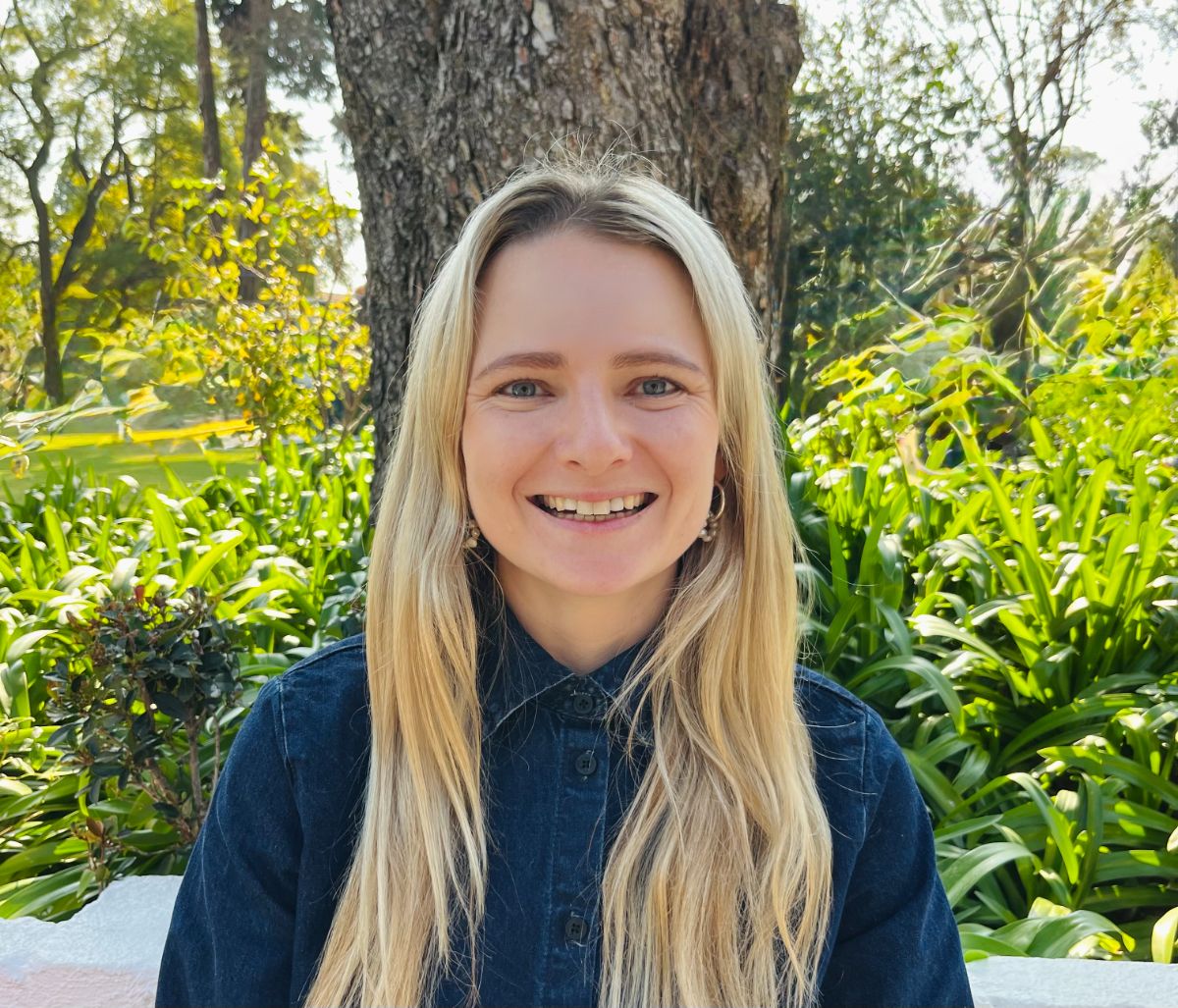
Kate La Trobe, BCBA and ADHD Executive Functioning Coach
I turn the profile into strategies you can actually use at home, at school and at work, and I can take you through it in a feedback session or carry it into coaching.
No. It maps thinking preferences, not conditions, and it doesn't replace an assessment.
Preferences tend to stay fairly stable, but how you use them changes with your circumstances, stress and experience. That's why the profile focuses on what you do with your preferences.
No. You can have a profile on its own.
Part of Breaking All Barriers. NBI® profiling is delivered through Breaking All Barriers, the business Lauren and I run together. It's where you'll find every profile type, training for schools and teams, and The Integrated Brain Classroom.
Visit Breaking All Barriers →Ready to see your brain's map?
NBI® is a registered trade mark of its owners. Kate La Trobe and Breaking All Barriers are independent practitioners and are not affiliated with or endorsed by the NBI® organisation.